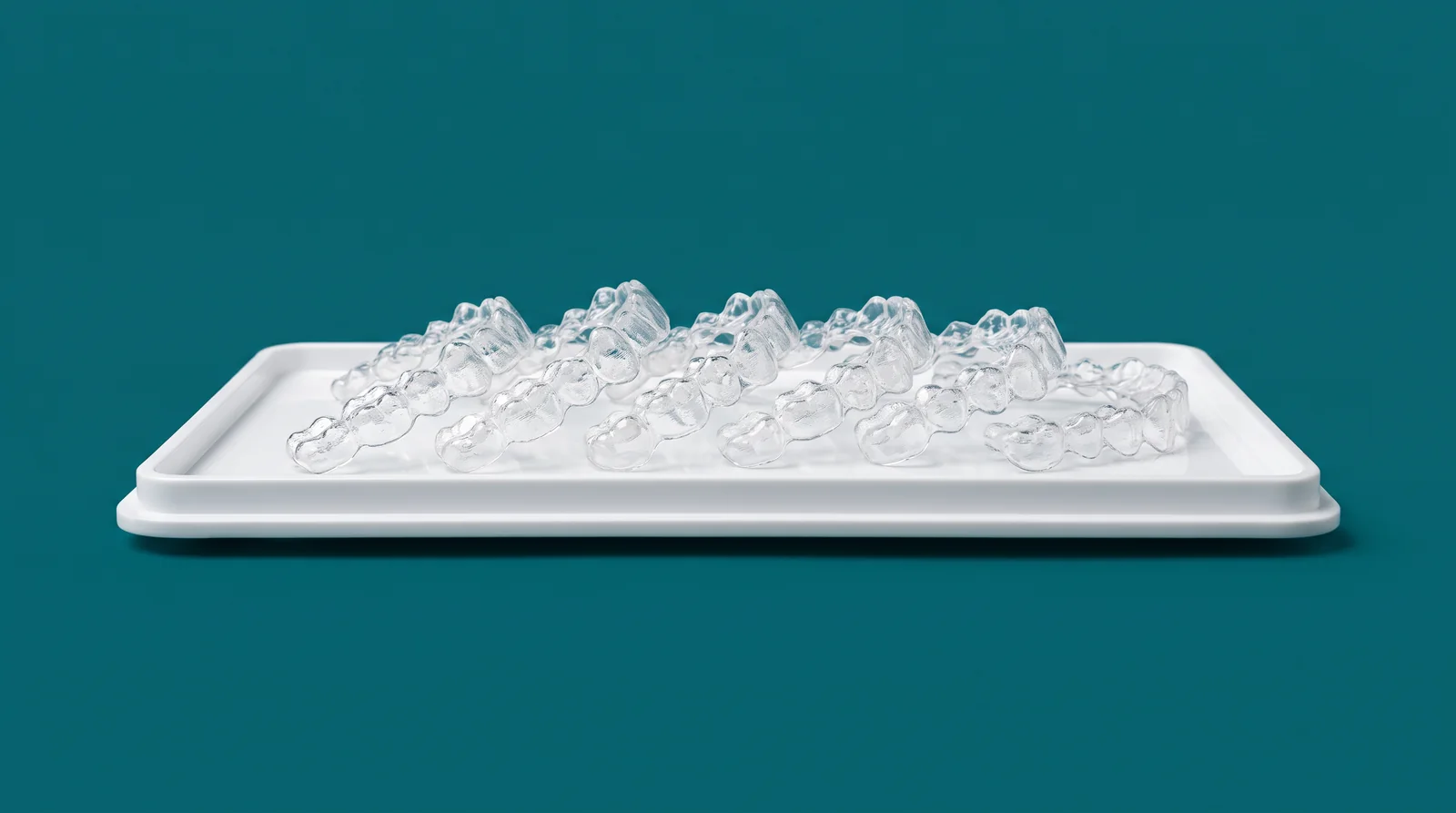
The material of a single tray really does cost only a few euros; a cost analysis by our manufacturing partner therefore regards the aligner itself as the cheapest part of in-office fabrication. Anyone who concludes from this that in-house fabrication is a money-saver overlooks the fact that they are opening a small medical device production facility inside their practice, with everything that entails. This article runs the numbers, drawing on three sources: two cost analyses by the manufacturing partner and the first-hand account of a Spanish orthodontist who runs one of the country's largest orthodontic clinics and, at the same time, one of its most extensively equipped in-house setups.
At a glance
- A complete in-house production line typically costs $80,000 to $250,000 in equipment alone, before software, staff, materials and quality management (industry estimate, as of 2026).
- Counting equipment only, industry guides put the in-house breakeven at around 20 to 30 aligner cases per month (hardware payback around 12 to 18 months); all further costs push the true breakeven significantly later.
- Real-world figures from in-house operation: €0.40 to €1.80 per printed model, €1 to €3 in material per aligner, 45 to 50 aligners per hour with manual trimming (practitioner's own account).
- The practitioner's verdict: including all costs, the in-house aligner can match or exceed outsourced fabrication.
The visible costs: equipment and software
Anyone serious about fabricating in the practice needs dental 3D printers, post-processing and curing units, thermoforming or pressure-forming machines, marking equipment, plus trimming and polishing stations. The range spans from a basic chairside setup in the low thousands to a complete line, for which $80,000 to $250,000 in equipment alone is the norm (industry estimate, as of 2026). On top of that come ongoing software licences, billed per case, per workstation or by subscription. According to this practitioner's assessment, independent planning solutions today cover around 98 % of clinically required functions, but demand more manual intervention and thus more clinician time.
The hidden costs: day-to-day operations
More interesting than the purchase is the daily routine. The practitioner's workshop numbers: a printed working model costs €0.40 to €1.80 depending on printer and resin class. Inexpensive printers allow open, low-cost resins but require constant staff attention: refilling, vat cleaning, recalibration, troubleshooting. Professional machines run more consistently but demand expensive proprietary resins. And: all printers eventually fail; anyone running volume needs duplicate machines, further increasing capital requirements and real unit costs.
The foil material typically comes in at €1 to €3 per aligner, multilayer foils for more consistent force delivery at the upper end, monolayer at the lower end. After thermoforming comes the most labour-intensive step: a trained assistant manages 45 to 50 aligners per hour with manual trimming, generally only with straight cut lines; scalloped trim lines are barely scalable by hand, and the finish rarely matches the quality of industrial laser trimming. Then: washing, curing, inspecting, sorting by patient and stage, bagging, labelling. As volume grows, this becomes a distinct operational burden.
The biggest item: regulation and responsibility
Aligners are medical devices. In-house fabrication means documented processes, quality control, traceability and ongoing staff time for quality management, in Europe within the framework of the MDR and ISO 13485. Calibration drift, material defects and capacity bottlenecks at peak times fall within your own area of responsibility, as does liability. This block appears in hardly any back-of-the-envelope calculation; in the manufacturing partner's analyses, it is the most frequently underestimated item.
The breakeven calculation
The formula is simple: breakeven cases = total fixed costs ÷ savings per case. The typical mistake is to use only the equipment list price as fixed costs. On this incomplete basis, industry guides cite a breakeven from around 20 to 30 aligner cases per month, with hardware amortisation in roughly 12 to 18 months. Factor in staff, software, downtime, machine duplication and compliance, and the true breakeven shifts significantly later, and most practices overestimate their future volume. The manufacturing partner's analysis concludes that in-house projects rarely fail on the workbench; they fail in the cost calculation.
The practitioner's verdict
The Spanish orthodontist's conclusion is remarkable precisely because he does not evaluate in-house fabrication in theory but runs it himself at scale: when staff and clinician time, equipment, maintenance, repairs, machine duplication and process friction are fully accounted for, the price per self-made aligner can match or even exceed outsourced fabrication. His recommendation for many clinics is a hybrid model: diagnostics and treatment planning stay in the practice, while fabrication is handled by a specialised partner who typically delivers industrially trimmed, sorted and labelled aligners within a week.
What this means for the decision
For practices with a consistently high, stable case volume, in-house fabrication can work, as a deliberately managed production operation with dedicated staff and a QMS. For the majority, the picture is different: with the partner model there is no capital outlay, costs accrue predictably per case (no costs without production), and the compliance burden of manufacturing rests with the certified manufacturer within the meaning of the MDR. Honestly calculated, the manufacturing partner's analysis finds that the comparison comes out clearly in favour of the partner model for the vast majority of practices. Role clarity remains essential: the manufacturing partner produces according to an approved plan; clinical control, plan approval and every therapeutic decision remain entirely with the treating dentist.
This article in German: Deutsche Version
Sources
- Cost analyses by the manufacturing partner on in-office fabrication (two articles), as of 2026; accessed August 2026; manufacturer data and industry estimate (equipment $80,000 to $250,000, breakeven 20 to 30 cases per month, payback 12 to 18 months); dollar amounts are the US market prices cited there.
- First-hand account of a Spanish clinic owner with in-house fabrication, documented in the manufacturing partner's publications; accessed August 2026; practitioner experience (€0.40 to €1.80 per model, €1 to €3 material per aligner, 45 to 50 aligners per hour, around 98 % feature coverage), not CLARIQUE's own research.
Professional information for dental professionals under § 2 HWG (German Act on Advertising in the Health Care System). Clarique Dental GmbH does not provide dental treatment and does not refer patients; diagnosis, patient information and treatment are carried out exclusively by dentists. This article does not replace legal or billing advice.
Read more
Your own aligner line for practices and practice groups: what lies behind it
Private label instead of a third-party brand: infrastructure, regulation and how to recognise a reputable manufacturing partner.
Practice economicsThe aligner market in numbers: what 20 million orthodontic cases per year reveal
Market distribution, the missing middle and why Germany is Europe's largest aligner market.
WorkflowFrom intraoral scan to approved setup: how professional aligner treatment planning works
Case commissioning, plan discussion, revisions, approval: the complete planning workflow in detail.
Price list and samples for your practice
Non-binding enquiry, we usually reply within one working day.