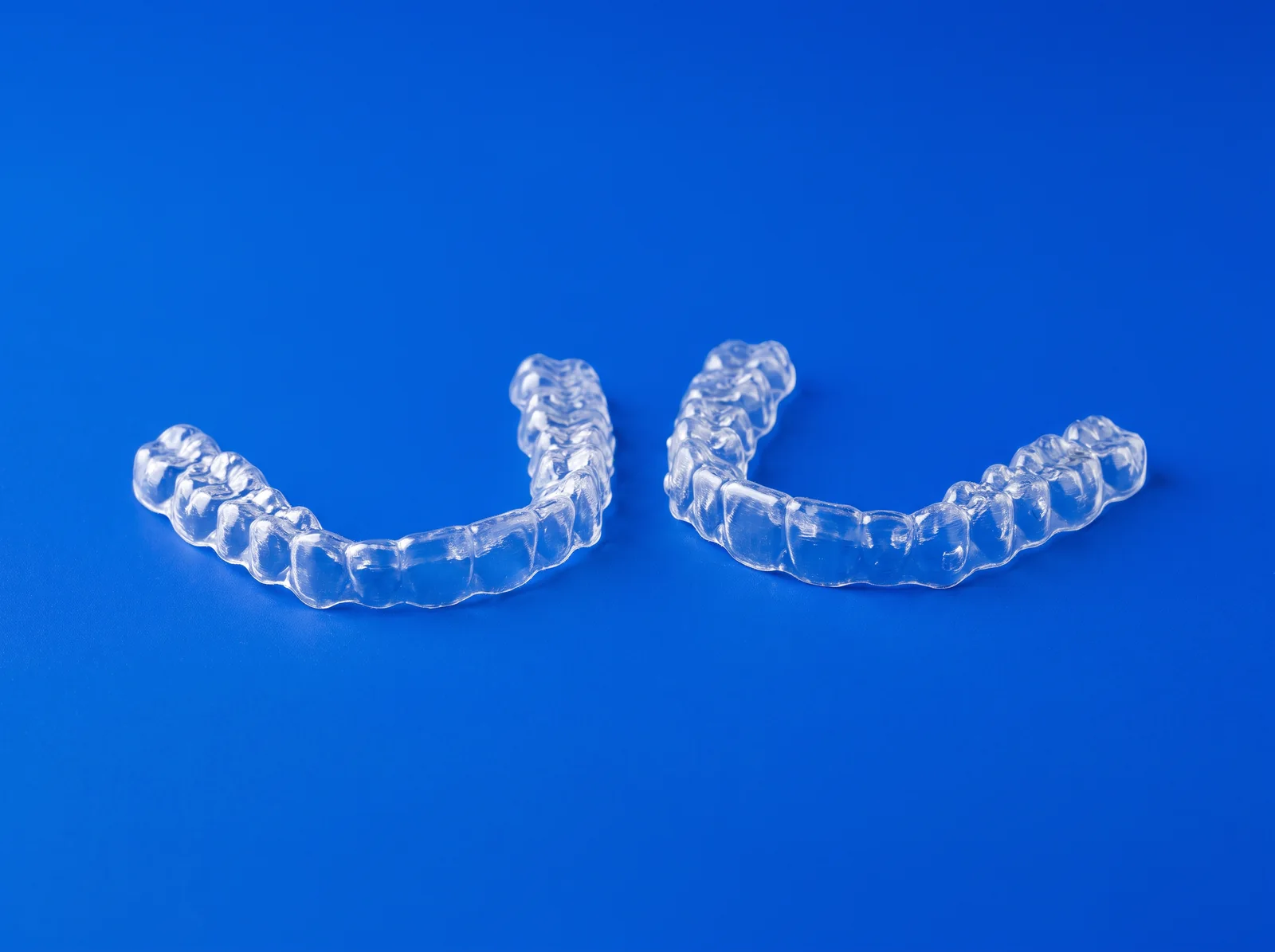
Discussions about aligner systems tend to be dominated by software features and workflows. What easily slips out of view is what physically carries the treatment: the material. With clinical expertise being equal, it is the foil that determines force level, force retention and tracking; to put it bluntly, the material is the treatment. This article summarises the current state of material science as compiled by CLARIQUE's certified manufacturing partner in its professional publications.
At a glance
- An aligner is a mechanical system: the offset between tooth position and tray geometry generates the orthodontic force through deformation of the thermoplastic.
- Thermoplastics lose stress over wear time (force decay); this is not a defect, but intrinsic viscoelasticity.
- Four material generations: PETG, TPU, polymer blends, multilayer; multilayer systems deliver more consistent forces and slower force decay.
- Common aligner polymers achieve light transmission above 92 % at a refractive index of around 1.5; it is primarily the surface finish that determines visibility in the mouth (manufacturer publication, as of 2026).
- Manufacturer claim by the manufacturing partner (as of 08/2026): multilayer material with up to 40 % lower insertion forces compared with conventional aligners, thermoformed on 3D-printed models produced at 70-micron precision.
The aligner as a mechanical system
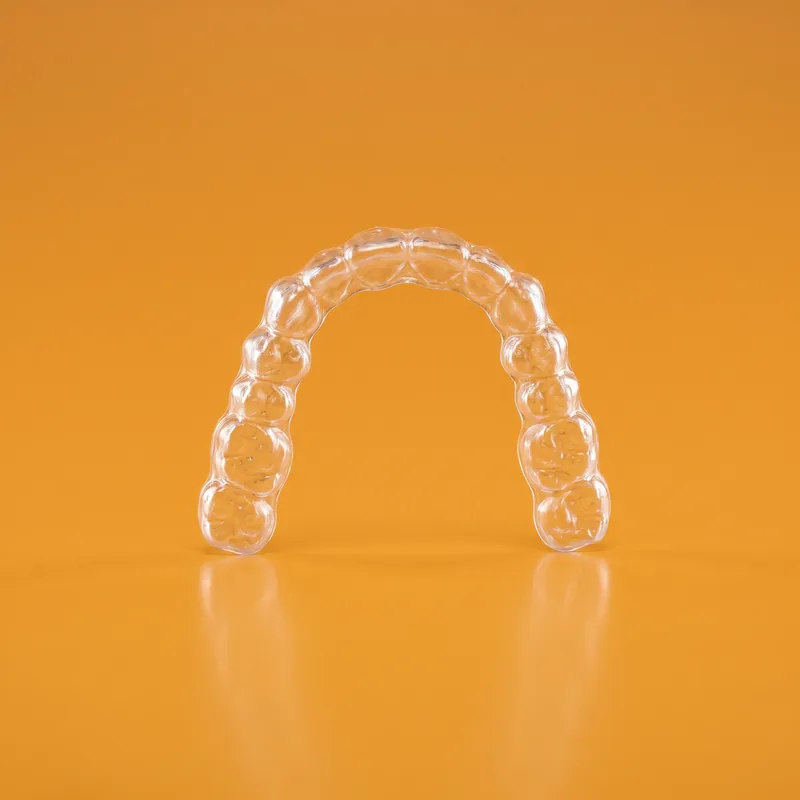
Every tray is deliberately shaped "wrong": it does not reproduce the current clinical tooth position but the target position of the respective treatment step. On insertion, the material must deform elastically; it is precisely this deformation that stores the energy transmitted to the teeth as a continuous force. A cascade then begins that every thermoplastic goes through: adaptation to the tooth surface, gradual stress loss (force decay), microscopic wear, declining force delivery. Important for clinical context: this force decay is not a quality defect but the intrinsic viscoelasticity of thermoplastic polymers. Unlike metals, whose elastic behaviour remains predictable over wide ranges, plastics "work" under sustained load; they relax.
Four material generations
PETG: the transparent baseline
PETG offers good optical clarity and relative stiffness. The downside: the force level drops sharply within hours. In everyday wear, the active appliance becomes a largely passive shell comparatively quickly; the planned movement is then no longer supported with the intended force.
TPU: more elastic, but less stable
Thermoplastic polyurethane is more elastic, behaves more favourably around undercuts and is perceived as more comfortable by many patients. Over wear time, however, it loses dimensional stability.
Polymer blends: the compromise
Blends of PETG and TPU combine stiffness and elasticity and are more stable than either component alone, but they inherit the fundamental limitations of thermoplastic materials.
Multilayer: multi-layer systems as the current standard
Multilayer systems stack polymers with different mechanical properties. The result is more consistent force delivery over the wear period, better tracking and slower force decay, while the functional lifespan of each individual tray remains limited. CLARIQUE's certified manufacturing partner processes biocompatible, FDA-cleared multilayer materials and states up to 40 % lower insertion forces for its system compared with conventional aligners (manufacturer claim, as of 08/2026). This is relevant for comfort on insertion and removal, without constituting any statement about individual treatment outcomes. The fit is based on 3D printing of the working models at 70-micron precision prior to thermoforming.
Outlook: shape-memory polymers
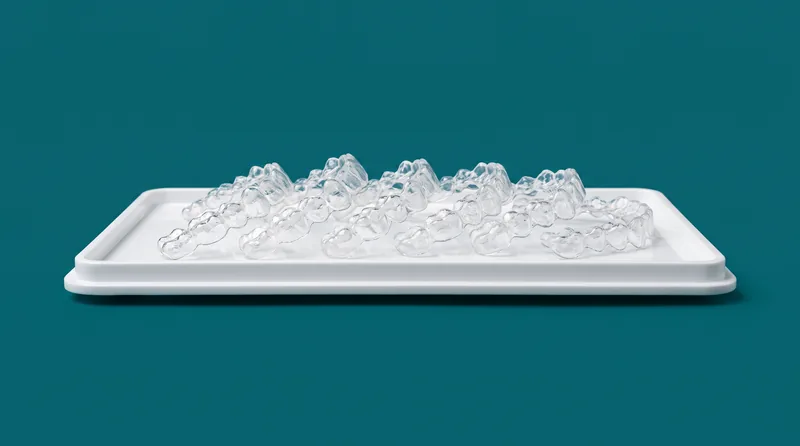
The next stage of development is emerging in the form of programmable materials. Shape-memory polymers (SMP) feature so-called switching segments that soften at elevated temperature, and can store both a permanent and a temporary shape. A single appliance could thus express multiple movement phases: instead of a tray change every seven to ten days, an SMP device could be reactivated several times. That would be a paradigm shift from the disposable shell to the programmable orthodontic appliance. For now this is an outlook, not clinical routine; but the direction is clear: the coming decade of aligner therapy will be shaped more by materials than by software features.
A note on optics: why "crystal clear" does not mean "invisible"
A common misunderstanding in patient consultations concerns transparency. Common aligner polymers achieve light transmission above 92 % at a refractive index of around 1.5, so the material is rarely the issue. What matters is the surface finish: a high-gloss tray reflects light directionally and produces a sharp specular highlight that gives the aligner away on the teeth. A surface with fine micro-grooves, by contrast, scatters incoming light in many directions; no single reflection is strong enough to stand out. This leads to an apparent paradox: the tray that looks perfectly clear in the hand can be the most conspicuous in the mouth, while a slightly matte one visually recedes. For the consultation, this means the only valid test is the inserted tray under normal room lighting at conversational distance, not inspecting the tray in the hand.
Implications for the practice
From the material perspective, three sober conclusions follow. First: change intervals and staging should match the force profile of the material in use; a material with rapid force decay behaves clinically differently from a multilayer system with slower force decay. Second: when evaluating an aligner system, the material question belongs on the same level as software and logistics; comparing planning features alone means comparing half the treatment. Third: material metrics are manufacturer data and replace neither diagnostics nor clinical judgement; selecting the appropriate system, staging and change intervals always rests with the treating dentist.
This article in German: Deutsche Version
Sources
- Manufacturing partner publications on material generations, force decay, shape-memory polymers and optics (light transmission above 92 %, refractive index around 1.5 for common aligner polymers), as of 2026; accessed August 2026; manufacturer publication.
- Manufacturer data from the manufacturing partner on multilayer material, up to 40 % lower insertion forces and 70-micron printing, as of 08/2026; accessed August 2026; manufacturer claim without a published test method, not CLARIQUE's own research.
Professional information for dental professionals under § 2 HWG (German Act on Advertising in the Health Care System). Clarique Dental GmbH does not provide dental treatment and does not refer patients; diagnosis, patient information and treatment are carried out exclusively by dentists. This article does not replace legal or billing advice.
Read more
Planning predictable aligner treatments: five data-driven principles
Case selection, biomechanics, attachments, staging and refinement management, with a checklist before case approval.
WorkflowPlanning software and clinical control: where clinical authority resides
Closed ecosystems or open workflows, and why the final approval must stay with the clinician.
Practice economicsHow to read and calculate refinement rates correctly
A survey covering 2,937 treatments shows refinement rates above 70 %, and how practices measure their own rate correctly.
Price list and samples for your practice
Non-binding enquiry, we usually reply within one working day.