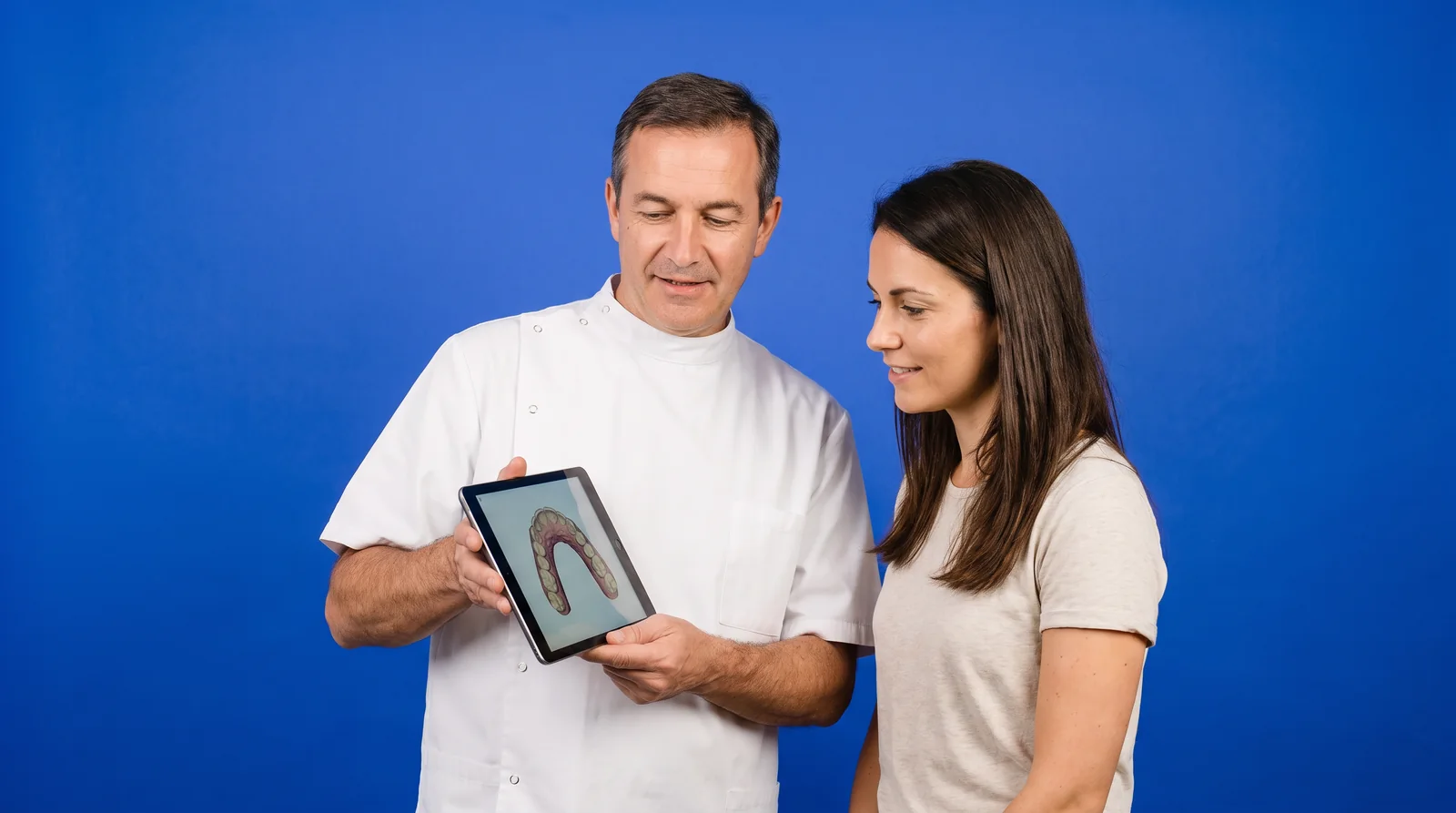
In aligner therapy, the appliance itself is the final step of a long digital process. Everything that matters clinically, that is the movement sequence, force application, attachment design and interproximal enamel reduction, is decided beforehand in the planning software. And that is precisely where it is decided who actually directs the therapy: the clinician, or an algorithm whose proposals are approved sight unseen.
At a glance
- Planning software generates automated setups; yet clinical responsibility for every approved setup always rests with the treating clinician.
- Platforms differ least on highly predictable movements and most on torque, rotation and extrusion.
- A five-question checklist reveals whether a software package allows genuine staging control or pre-empts clinical decisions.
- In the CLARIQUE workflow, every digital setup is reviewed and approved by the clinician before production; clinical authority stays in the practice.
Automation is not neutral
Modern planning systems deliver a complete setup within a short time: target position, intermediate stages, attachment proposals, IPR distribution. That is a large gain in efficiency, but it carries a structural risk. An automatically generated staging is based on average assumptions about tooth movement, not on the individual findings. The software will approve virtually any requested movement; whether the biology will follow is something it does not check. Anyone who confirms an automated setup unchanged is, in effect, delegating clinical decisions to an algorithm, with direct consequences for tracking, treatment duration and refinement needs.
The differences between the systems available on the market are unevenly distributed. One finding that is consistent across the professional literature: for highly predictable movements, such as resolving mild crowding, the platforms differ very little. The greatest differences appear in the movement classes that are hardest to predict: torque, rotation and extrusion. It is precisely there that it becomes apparent whether a software package gives the clinician the necessary means of intervention or not.
Macro- and micro-staging: the real lever
Advanced planning concepts distinguish two levels of control. Macro-staging concerns the overall sequence of treatment, for example the decision to complete molar distalisation before retracting the anterior segment so as not to squander anchorage. Micro-staging breaks a single tooth movement down into phases: a canine rotation, for instance, can be divided into a derotation phase, a torque phase and a settling phase, rather than attempting everything simultaneously. This distinction becomes particularly relevant for antagonistic movements such as intrusion versus retraction, and for synergistic combinations such as expansion plus distalisation.
Whether a software package actually permits this level of control can be tested with five questions:
- Can rotation and torque be staged independently of each other, with increments of less than 1.5 degrees per stage?
- Is manual overcorrection possible per tooth and per movement type?
- Is the attachment geometry fully customisable and sequenceable in phases?
- Can the automated staging be overridden with a custom sequential movement order?
- Can IPR be planned stage-specifically, with visualisation of the contact points?
If any of these questions is answered with no, the software is making clinical decisions on the clinician's behalf at that point. In complex cases, that is a direct driver of the refinement rate.
Planning as a service without loss of control
The fact that demanding setup work takes time is the reason specialised planning service providers have emerged. The model of the CLARIQUE planning partner TP Solution GmbH (Cologne) shows how delegation and clinical authority can be reconciled: their orthodontic dental technicians do not work in a separate, additional tool, but directly in the setup software of the respective aligner manufacturer, via a staff account set up by the clinician. The clinician therefore always sees the same planning status as the technician, in the familiar system.
What matters is the division of roles: the technician prepares the setup according to the clinician's documented clinical preferences, handles the communication with the manufacturer's lab, and only gets in touch once he or she considers the plan predictable. The finished plan is then discussed by phone or in writing; revision loops are unlimited. The case, however, is approved exclusively by the clinician; only his or her confirmation in the software triggers production. According to its own figures, TP Solution has processed over 200,000 treatment plans and records, on average, a 30 percent reduction in refinement rates among its clients (TP Solution's own figures, as of 08/2026).
The same principle applies on the manufacturing side. At CLARIQUE's certified manufacturing partner, according to company figures, over 40 employed orthodontists review incoming cases and digital setups before production begins (manufacturing partner's own figures, as of 08/2026); software assists, but never decides alone. Production is carried out exclusively on the basis of a setup that the clinician has previously reviewed and approved.
What this means for the practice
Clinical authority is not a question of the tool, but of the process. Three conclusions can be drawn:
- Treat software as a clinical instrument. Practices with low refinement rates do not use planning software as a convenience feature, but as an instrument whose proposals are systematically questioned, especially for torque, rotation and extrusion.
- Take approval seriously. The approval of the setup is the point at which responsibility formally and factually rests with the clinician. An approval process with documented review, including revision loops where necessary, is not a delay, but quality assurance.
- Delegate, yes; relinquish, no. Planning service providers and reviewing clinical teams at the manufacturer relieve the practice of setup craftsmanship and manufacturer communication. Diagnosis, indication and the final therapeutic decision remain unaffected and stay with the clinician, legally and professionally.
For CLARIQUE partner practices, this principle is structurally embedded: planning is carried out by specialised orthodontic dental technicians, manufacturing by a manufacturing partner certified to EN ISO 13485 with per-case documentation under the MDR; nothing is produced except what the clinician has approved. The software is the tool. Clinical authority resides in the practice.
This article in German: Deutsche Version
Sources
- Manufacturing partner publications on planning software, macro- and micro-staging and clinical case review, as of 03/2026 and 01/2026; accessed August 2026; manufacturer publication.
- TP Solution GmbH (Cologne), service and workflow information at tpsolution.com (over 200,000 treatment plans, on average 30 % lower refinement rate among clients); accessed August 2026; company's own figures.
- Manufacturer data from the manufacturing partner on case review by employed orthodontists, as of 08/2026; accessed August 2026 (manufacturer data).
Professional information for dental professionals under § 2 HWG (German Act on Advertising in the Health Care System). Clarique Dental GmbH does not provide dental treatment and does not refer patients; diagnosis, patient information and treatment are carried out exclusively by dentists. This article does not replace legal or billing advice.
Read more
From intraoral scan to approved setup: how professional aligner treatment planning works
Case commissioning, plan discussion, revisions, approval: the complete planning workflow in detail.
ClinicalPlanning predictable aligner treatments: five data-driven principles
Case selection, biomechanics, attachments, staging and refinement management, with a checklist before case approval.
ClinicalMaterial science and biomechanics of modern aligners
From PETG to multilayer: how material generations change force delivery, wearing comfort and transparency.
Price list and samples for your practice
Non-binding enquiry, we usually reply within one working day.