The following article is an anonymised single-case report from the international manufacturing network of CLARIQUE's certified manufacturing partner. It is intended as professional information for dental professionals and does not constitute a promise of treatment outcome; treatment courses and results cannot be transferred to individual cases. Diagnosis, indication and therapy rest exclusively with the treating clinician. No image material is included.
At a glance
- Female patient, 34 years; chief complaints: anterior gap due to open bite, TMJ clicking with pain on mouth opening
- Findings: anterior open bite of 3 to 4 mm, TMD with mild condylar displacement, tongue thrust, mild crowding of the upper anteriors
- Approach: three stages, splint therapy (Aquasplint), habit correction (Bluegrass appliance), followed by clear aligner therapy with posterior intrusion
- Course: bite closure within 12 months per the documentation; patient pain-free, no further joint clicking
Initial findings
A 34-year-old female patient presented with two concerns: an anterior gap she found bothersome, clinically an anterior open bite, and pronounced clicking in the temporomandibular joint with pain on mouth opening. Diagnostics revealed:
- anterior open bite of 3 to 4 mm
- mild crowding of the upper anteriors
- Class I relationship at the canine and molar on the right, mild Class II canine relationship
- mild condylar displacement on mouth opening
- temporomandibular disorder (TMD)
- tongue thrust on swallowing
These findings illustrate why the anterior open bite is considered one of the most demanding tasks in aligner therapy: it is rarely a purely dental problem. In the present case, a functional component (TMD with condylar displacement) and a habitual component (tongue thrust) coincided; both would foreseeably have undermined any tooth movement started immediately.
Staged treatment plan
Treatment was therefore deliberately sequenced:
- TMD pre-treatment: First, the patient wore an Aquasplint for one and a half months to calm the TMD symptoms and unload the temporomandibular joint. Starting orthodontic treatment into a painful, decompensated joint would have been justifiable neither diagnostically nor therapeutically.
- Habit correction: A Bluegrass appliance was then used for four to six months to correct the tongue thrust. Without control of tongue function, any orthodontically achieved anterior bite closure is considered prone to relapse.
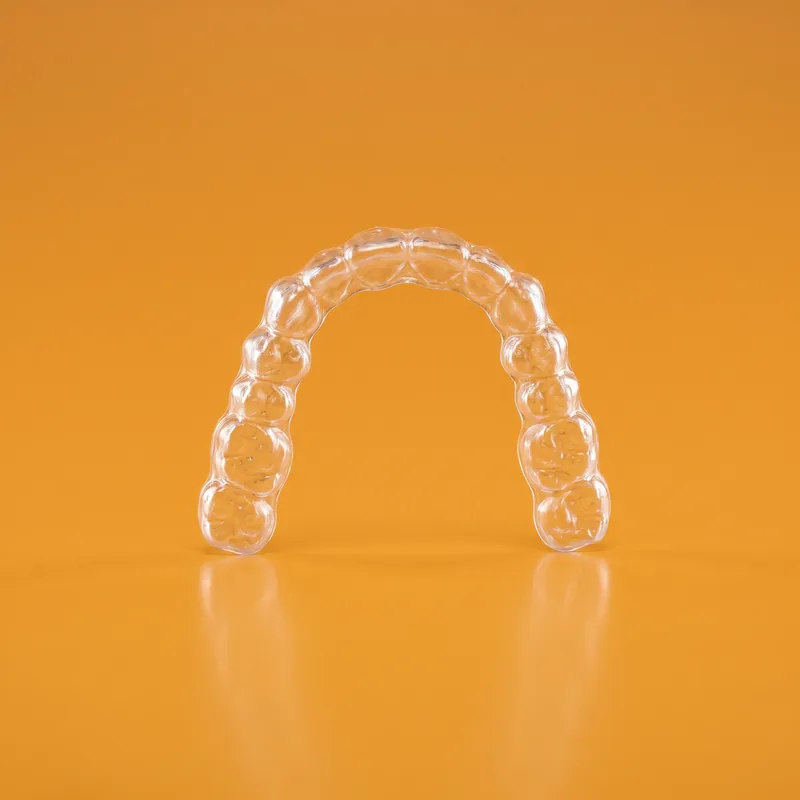
- Aligner phase: Only then did the actual clear aligner therapy begin, with aligners manufactured by our certified manufacturing partner. Attachments on the buccal teeth served the controlled intrusion of the posterior teeth.
The biomechanical concept of the aligner phase followed the logic of the "counterclockwise effect" of posterior intrusion: when the posterior teeth are intruded, the mandible can rotate in an anterior-cranial direction; the anterior bite closes without the anteriors having to be excessively extruded. In the documented case, this mechanism had a dual effect: the intrusion of the posterior teeth simultaneously unloaded the temporomandibular joint and guided the condyle into a more favourable position.
Course and outcome
The documented course: as early as six months after completion of the Bluegrass phase, the anterior open bite was closed. The condylar position was markedly corrected compared with the initial findings; the patient was pain-free and the joint clicking no longer occurred. For the resolution of the 3 to 4 mm open bite including the accompanying TMD symptoms, the case documentation states a total period of twelve months. The documentation does not include a figure for the number of aligners.
Discussion
Three aspects of this case are instructive beyond the individual course:
Diagnostics before mechanics. The treatment outcome was achieved not primarily through the aligners, but through the right sequence: first functional diagnostics and joint stabilisation, then habit control, then tooth movement. Had the aligner therapy started without pre-treatment, the TMD and the tongue function would in all likelihood have compromised the result, regardless of the quality of the setup.
Intrusion is plannable, but demanding. Posterior intrusion is among the movements in which attachment design and the anchorage concept decide between success and loss of tracking. At the same time, extrusive and intrusive tasks are among the movement classes with the lowest predictability, one reason why planning such cases belongs in experienced hands, and why the setup should be critically reviewed before production.
Think interdisciplinarily. The case combines functional therapy, myofunctional therapy and orthodontics. For the practice, this means: in open bites with TMD symptoms or habitual factors, the staged approach is not a detour, but a prerequisite for a stable result.
Stability depends on the cause, not on the appliance. The anterior open bite is considered one of the most relapse-prone groups of findings in orthodontics, especially when the causative tongue function is left untreated. That in the present case the habit correction preceded the tooth movement should therefore also be read as a retention strategy: a bite closure achieved against a persistent tongue thrust remains permanently under load. Aftercare, that is retention and monitoring of the myofunctional situation, accordingly remains an integral part of treatment planning and, like the therapy itself, rests with the treating clinician.
Here too, the caveat of every case report applies: this is a single, documented favourable course. Whether and within what timeframe a comparable presentation can be treated is decided solely by the clinician's individual diagnostics; this account establishes neither an expectation of success nor a promise of treatment outcome.
This article in German: Deutsche Version
Sources
- Anonymised case documentation from the manufacturing partner's manufacturing network, published in its professional publications, as of 01/2026; accessed August 2026; case report (single case, no promise of treatment outcome, results cannot be generalised).
- Manufacturer data from the manufacturing partner, accessed August 2026 (manufacturer data).
Professional information for dental professionals under § 2 HWG (German Act on Advertising in the Health Care System). Clarique Dental GmbH does not provide dental treatment and does not refer patients; diagnosis, patient information and treatment are carried out exclusively by dentists. This article does not replace legal or billing advice.
Read more
Case report: deep bite and crowding with aligners
Anonymised single-case report from the manufacturing network: findings, staging and course.
ClinicalPlanning predictable aligner treatments: five data-driven principles
Case selection, biomechanics, attachments, staging and refinement management, with a checklist before case approval.
WorkflowPlanning software and clinical control: where clinical authority resides
Closed ecosystems or open workflows, and why the final approval must stay with the clinician.
Price list and samples for your practice
Non-binding enquiry, we usually reply within one working day.