The following article is an anonymised single-case report from the international manufacturing network of CLARIQUE's certified manufacturing partner. It is intended as professional information for dental professionals and does not constitute a promise of treatment outcome; treatment courses and results cannot be transferred to individual cases. Diagnosis, indication and therapy rest exclusively with the treating clinician. No image material is included.
At a glance
- Female patient, 25 years; chief complaint: crowding in the upper and lower arch
- Findings: moderate deep bite (4 to 5 mm), crowding 4 mm upper / 3 mm lower, lower midline deviation of 5 mm, bilateral Class II occlusion, retroclined upper anteriors
- Therapy: clear aligner treatment with interproximal enamel reduction (IPR)
- Duration: full correction in 10 months (per the case documentation)
Initial findings
A 25-year-old female patient presented with the wish to correct crowding in both arches. Clinical and model-based analysis revealed the following picture:
- skeletal Class II tendency
- Class II relationship at canines and molars, bilateral
- mild crowding in the maxilla (4 mm)
- mild crowding in the mandible (3 mm)
- midline deviation of the mandible of 5 mm
- moderate deep bite of 4 to 5 mm
- retroclined upper anterior teeth
This combination is clinically more demanding than the isolated presenting symptom of "crowding" would suggest: the deep bite and the retroclined anteriors reinforce each other, and the pronounced lower midline deviation calls for asymmetric movement planning.
Treatment planning and staging
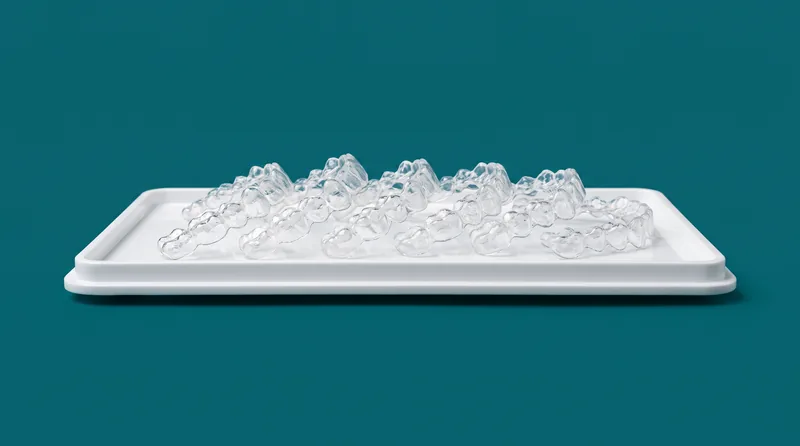
Treatment was carried out with clear aligners manufactured by our certified manufacturing partner. To resolve the crowding, interproximal enamel reduction (IPR) was planned in order to gain space without extraction or excessive proclination. The exact number of aligners is not stated in the underlying case documentation; what is documented is a total treatment time of ten months to achievement of the treatment objectives.
From a planning perspective, three points stand out in this combination of findings, consistent with the general principles of predictable aligner planning:
- Deep bite correction requires controlled vertical movements. Correcting a deep bite of 4 to 5 mm is one of those movement tasks where staging and the anchorage concept matter more than the sheer number of aligners. Uncontrolled intrusion planning without anchorage is among the classic causes of loss of tracking.
- IPR is a planning instrument, not a side issue. The amount, distribution and timing sequence of enamel reduction must fit the staging; in the present case, IPR was the central means of resolving the crowding in both arches.
- Plan asymmetries explicitly. A midline correction of several millimetres requires side-specific movement sequences; a purely symmetric auto-setup does not, as a rule, adequately model such cases.
Added to this are the retroclined upper anteriors: their uprighting is doubly relevant in this presentation, because the proclination or torque correction of the anterior teeth simultaneously contributes to bite opening and facilitates the sagittal correction. Torque movements, however, are among the movement classes in which planning quality and attachment strategy show up most clearly in clinical tracking, a further reason to review the setup in detail before approval.
Outcome
After ten months, the case report documents the following treatment outcome:
- crowding resolved in the upper and lower arch (with the use of IPR)
- canine and molar relationship brought close to Class I, with a small documented residual deviation
- overjet and overbite stabilised, the moderate deep bite corrected
- correction of the lower midline by 4 mm
The essential treatment objectives, that is resolution of the crowding, bite opening and substantial midline correction, were thus achieved within the documented treatment time. The small residual deviation from an ideal Class I occlusion is transparently reported; it illustrates a point that is repeatedly emphasised in the aligner literature: fine sagittal corrections across the full length of the arch are among the movements with more limited predictability, and an honestly documented, clinically stable result is more meaningful than an idealised presentation.
Discussion
The case shows that a combination of moderate deep bite, bilateral crowding and pronounced midline deviation can be treated with aligners within a manageable timeframe, given careful case selection and planning. Two points of context appear important:
Case selection remains the most important decision. The crowding here was in the mild range at 3 to 4 mm, the periodontium was sound, and the movement objectives stayed within biological limits. It is precisely this constellation that makes a ten-month treatment time without documented mid-course corrections plausible. With more pronounced deep bites, greater space requirements or pre-existing periodontal damage, longer treatment times and a greater need for corrections should be expected.
A single case does not establish an expectation. Published case reports naturally depict successful courses. The literature describes refinement rates of 40 to 60 percent across all case classes (industry estimate cited in manufacturer publications, as of 2026); an additional correction is therefore a regular part of aligner therapy even with good planning, not a failure. The present account should accordingly be read as a single-case report: it describes one documented course of treatment, not an expected standard treatment and not a promise of treatment outcome.
What is relevant for the practice is less the specific result than the way it was reached: complete diagnostics beyond the presenting symptom, a staging that addresses vertical, transverse and asymmetry tasks separately, and IPR planning that is part of the setup from the outset, reviewed and approved by the clinician before the first aligner is manufactured.
This article in German: Deutsche Version
Sources
- Anonymised case documentation from the manufacturing partner's manufacturing network, published in its professional publications, as of 01/2026; accessed August 2026; case report (single case, no promise of treatment outcome, results cannot be generalised).
- Planning principles from the same publication series of the manufacturing partner, as of 01/2026; accessed August 2026; manufacturer publication.
- Refinement rates of 40 to 60 % across all case classes, cited in manufacturer publications; accessed August 2026; industry estimate, not CLARIQUE's own research.
Professional information for dental professionals under § 2 HWG (German Act on Advertising in the Health Care System). Clarique Dental GmbH does not provide dental treatment and does not refer patients; diagnosis, patient information and treatment are carried out exclusively by dentists. This article does not replace legal or billing advice.
Read more
Case report: anterior open bite with TMD pre-treatment
Complex starting situation, interdisciplinary approach and staging as an anonymised single-case report.
ClinicalPlanning predictable aligner treatments: five data-driven principles
Case selection, biomechanics, attachments, staging and refinement management, with a checklist before case approval.
Practice economicsHow to read and calculate refinement rates correctly
A survey covering 2,937 treatments shows refinement rates above 70 %, and how practices measure their own rate correctly.
Price list and samples for your practice
Non-binding enquiry, we usually reply within one working day.